
Commercial law, legal information
Business Debt Recovery in Delhi: 4 Legal Routes (2026)
Business debt recovery in Delhi can run through a cheque dishonour complaint, an MSME delayed-payment reference, a commercial or civil suit, or, for large undisputed debts, insolvency proceedings. This guide explains each route, the deadlines that apply, and includes two tools to test your own dates and facts.
Business debt recovery in Delhi: the four routes at a glance
Business debt recovery in Delhi usually concerns money owed for goods supplied, services rendered or contractual obligations. Before choosing a route, confirm the contractual basis of the claim and the amount actually outstanding. The right remedy depends on the facts, the documents, the dates and the law that applies.
| Route | Governing law | Examine it when | Time-sensitive point |
|---|---|---|---|
| Cheque dishonour | Section 138, Negotiable Instruments Act, 1881 | A cheque issued for a legally enforceable liability was returned unpaid. | Demand notice within 30 days of the bank's information |
| MSME delayed payment | MSMED Act, 2006, Sections 15 to 18 | The supplier is an eligible micro or small enterprise. | Statutory payment period of up to 45 days |
| Commercial or civil suit | Commercial Courts Act, 2015; Code of Civil Procedure, 1908 | A money claim is supported by a contract, invoices and records. | Generally three years, depending on the claim |
| Insolvency | Insolvency and Bankruptcy Code, 2016 | Operational debt of ₹1 crore or more is due and not genuinely disputed. | Statutory demand notice, then application |
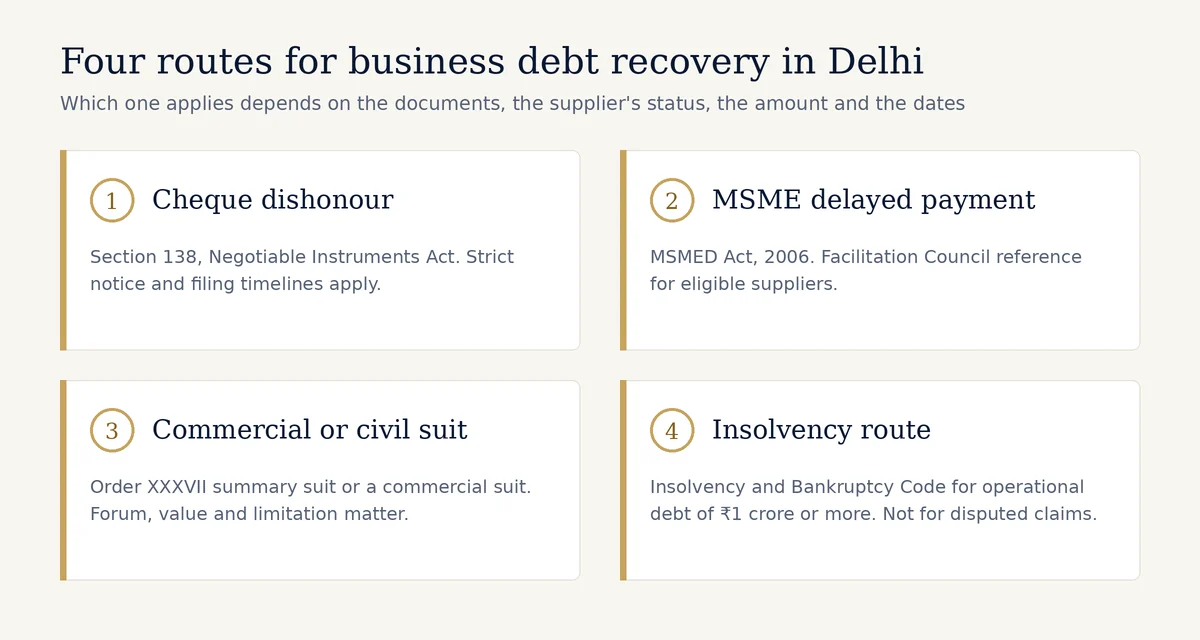
An invoice alone does not settle enforceability. The contract, performance, acceptance, payment history and any objections raised by the buyer can all matter.
Which business debt recovery in Delhi route fits your claim?
Answer three questions to see which routes are worth examining for business debt recovery in Delhi on your facts. The tool runs in your browser and stores nothing.
Recovery of unpaid invoices in Delhi
Recovery of unpaid invoices in Delhi starts with evidence. A claim should show the transaction, the obligation to pay and the balance claimed, and organising these records early helps to identify disputed items. Tick what you already hold.
0 of 8 gathered
Legal notice for outstanding payment
A notice can set out the transaction, the contractual basis, the amount claimed and the relief sought, and can give the other side a chance to settle. Whether a notice is mandatory depends on the statute, the contract and the claim.
Reconcile before you rely on a figure
Separate principal from payments, credit notes, deductions and disputed entries. Check payment terms, interest clauses, dispute-resolution clauses and jurisdiction clauses in the contract.
Section 138 cheque bounce and business debt recovery in Delhi
In business debt recovery in Delhi, where a cheque issued for a legally enforceable debt is dishonoured, Section 138 of the Negotiable Instruments Act can give a statutory remedy if every condition is met. The sequence is strict: present the cheque within its validity, send a written demand notice within 30 days of the bank's information, allow the drawer 15 days to pay, and file the complaint within one month after that period ends.
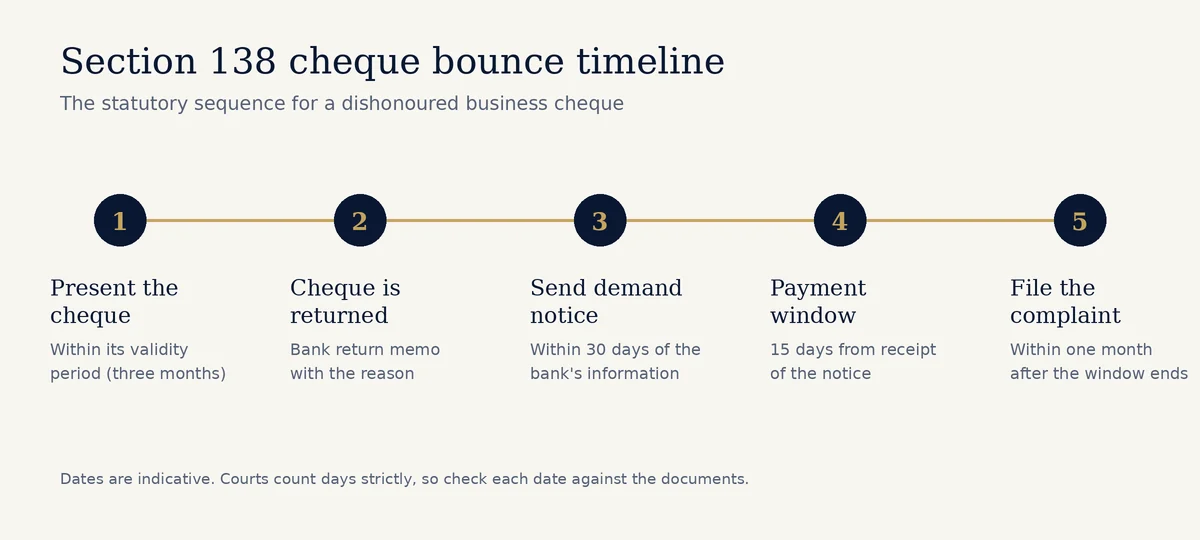
These dates are indicative. Courts count days strictly, and a court may condone delay in filing the complaint on sufficient cause. Check every date against the original documents before you act.
Interim compensation and appeal deposits
Section 143A allows the trial court to direct the drawer to pay interim compensation of up to 20% of the cheque amount, and the Supreme Court has held that this is discretionary. Section 148 lets an appellate court direct a deposit of at least 20% of the fine or compensation awarded.
Cheque case and civil suit are separate
A Section 138 complaint and a civil recovery suit are different routes with different requirements, and their interaction should be assessed on the facts. The same amount cannot be recovered twice.
For a focused guide, see our page on a cheque bounce lawyer in Delhi and our guide to commercial lease security cheque recovery.
MSME delayed payment and business debt recovery in Delhi
Business debt recovery in Delhi for eligible micro and small enterprises has a statutory delayed-payment framework under the MSMED Act, 2006. The supplier's status, registration, the transaction and the dates should be checked before relying on it, because registration status at the time of the contract or supply matters.
Section 15: time for payment
The buyer must pay a qualifying supplier on the agreed date, and where a written agreement fixes a period it cannot exceed 45 days from acceptance or deemed acceptance.
Section 16: interest
Compound interest with monthly rests runs at three times the bank rate notified by the Reserve Bank of India, subject to the Act and the facts of the claim.
Sections 17 and 18: recovery
Section 17 makes the buyer liable for the amount due with interest. Section 18 allows a reference to the Micro and Small Enterprises Facilitation Council for conciliation and, where appropriate, arbitration.
For buyers: Section 43B(h) of the Income-tax Act ties the tax deduction for payments to micro and small suppliers to the payment periods in the MSMED Act, which gives buyers a reason to settle these dues on time. Suppliers can file delayed-payment applications through the government's MSME Samadhaan portal.
Commercial recovery suits and insolvency in Delhi
In business debt recovery in Delhi, a recovery suit may follow where dues remain unpaid, subject to the contract, the evidence, limitation and jurisdiction. The forum turns largely on the value of the claim.
| Claim value | Likely forum | Points to check |
|---|---|---|
| Below ₹3 lakh | Ordinary civil court | Below the commercial "specified value"; Order XXXVII (summary suit) may be examined if its conditions are met. |
| ₹3 lakh to ₹2 crore | District commercial court | A commercial dispute of specified value; pre-institution mediation under Section 12A usually comes first unless urgent interim relief is sought. |
| Above ₹2 crore | Commercial Division, Delhi High Court | Original-side jurisdiction applies above ₹2 crore, subject to the Commercial Courts Act and the contract's jurisdiction clause. |
Jurisdiction can also depend on where the defendant is located, where the cause of action arose, the place of performance and the terms of the agreement. For related work, see our pages on a recovery suit lawyer, a commercial lawyer in Delhi and arbitration and mediation.
Insolvency is not a shortcut for collection. Under the Insolvency and Bankruptcy Code, an operational creditor can start proceedings only for a default of at least ₹1 crore, and a genuine pre-existing dispute about the debt can defeat the application. Our bankruptcy lawyer page covers this area.
Limitation for business debt recovery in Delhi
Limitation is the first check in any business debt recovery in Delhi matter. Many money claims carry a three-year limitation period under the Limitation Act, 1963, but the period and its starting point depend on the nature of the claim and the provision that governs it. For goods sold and delivered, the period generally runs from delivery or from the end of any agreed credit period.
What can restart the clock
A written acknowledgement of liability signed before the period expires, or a part-payment made within time, can give a fresh period under Sections 18 and 19 of the Limitation Act. Both must meet the statutory conditions.
A notice does not stop the clock
A legal notice, by itself, does not extend limitation. Identify when the claim accrued and review every relevant date before you decide on a route.
Related guides from Veeraya Legal
These pages cover the neighbouring areas that often come up alongside business debt recovery in Delhi.
Questions about business debt recovery in Delhi
How can a business recover unpaid invoices in Delhi?
Is business debt recovery in Delhi possible without going to court?
Can a cheque bounce case be filed for business dues?
Can an MSME approach the Facilitation Council for delayed payment?
Which court handles business debt recovery in Delhi?
Is pre-institution mediation compulsory for a commercial suit?
What is the limitation period for recovering an unpaid invoice?
Does a legal notice stop the limitation period?
Is a legal notice compulsory before a civil recovery suit?
Sources and authorities
Primary sources for business debt recovery in Delhi:
- India Code: bare texts of the Negotiable Instruments Act, 1881, the MSMED Act, 2006, the Commercial Courts Act, 2015 and the Limitation Act, 1963
- MSME Samadhaan: delayed-payment applications to Facilitation Councils
- eCourts Services: case status and court information
- Reserve Bank of India: the notified bank rate used for MSME interest