
Labour and employment law, legal information
Labour Court Lawyer in Delhi: Forums, Procedure and Time Limits
A labour court lawyer in Delhi appears in the Labour Courts and Industrial Tribunals of Delhi’s district courts, which sit at more than one of Delhi’s court complexes, in conciliation before the Labour Department and, where needed, in the Delhi High Court. This guide explains how labour disputes are heard after the Industrial Relations Code, 2020, and the time limits that apply, with a date planner.
Labour court lawyer in Delhi: five facts at a glance
1. Many courts
Delhi has many Labour Courts and Industrial Tribunals: state-sphere benches, Central Government Industrial Tribunals and labour authorities. Recent circulars place the state benches at Rouse Avenue, and a Labour Commissioner order allocates new references among them by area.
2. The forum is changing
The Industrial Relations Code, 2020 abolished Labour Courts in favour of two-member Industrial Tribunals, and existing Labour Courts continue for now under a stop-gap order.
3. Conciliation comes first
A worker covered by the Code’s grievance route applies for conciliation and can then apply directly to the Tribunal after 45 days from that application.
4. Two years
That direct application must be made within two years of the discharge, dismissal, retrenchment or termination.
5. The High Court
Orders and awards can be challenged by a writ petition in the Delhi High Court under Article 226.
Labour courts and Industrial Tribunals in Delhi: what changed
Before 21 November 2025, labour disputes in Delhi were adjudicated by Labour Courts and Industrial Tribunals under the Industrial Disputes Act, 1947. Delhi has many Labour Courts and Industrial Tribunals, in more than one category. Recent circulars of the Delhi District Courts (2022 to 2024) and the Labour Commissioner list state-sphere Industrial Tribunals I and II and Labour Courts 1 to 10 at the Rouse Avenue Court Complex. Older listings placed them at Karkardooma, and a Delhi High Court plea reported in the press records that they were shifted from Karkardooma to Dwarka in 2017, so older sources may name a different complex.
Disputes in which the Central Government is the appropriate government, such as those involving central bodies, banks and airports, go to the Central Government Industrial Tribunals-cum-Labour Courts at Delhi. The Ministry of Labour’s notice of 2017 describes CGIT-cum-Labour Courts Delhi-I and Delhi-II, and recent cause lists show them hearing matters at Rouse Avenue. The Ministry’s CGIT site gives the current location.
References of new industrial disputes to the state Industrial Tribunals and Labour Courts are made by the Joint and Deputy Labour Commissioners of the Labour Department’s district offices, which are listed in the next section. The state Tribunals and Labour Courts deal with disputes between employers and employees under the Industrial Disputes Act, now replaced by the Industrial Relations Code, and other labour laws.
New references are allotted by the Labour Commissioner’s order, which assigns areas to the Industrial Tribunals and Labour Courts. An order of April 2021 was superseded by a later order, and the allocation can change again, so the current order decides which court a new matter goes to. The Delhi State Legal Services Authority also runs a help desk for the Labour Courts on the third floor of the Rouse Avenue Court Complex.
The Industrial Disputes Act was repealed on 21 November 2025. The Industrial Relations Code, 2020 does not provide for Labour Courts. It provides for Industrial Tribunals, each with a judicial member and an administrative member, and for National Industrial Tribunals in matters of national importance. A labour court lawyer in Delhi therefore works across a forum in transition.
To avoid a gap, the Central Government issued the Industrial Relations (Removal of Difficulties) Order, 2025, which lets the existing Labour Courts and Tribunals continue to function until Tribunals are constituted under the Code. The Kerala High Court upheld that approach in February 2026, and the Karnataka High Court is reported to have held that Labour Courts keep their jurisdiction until the new Tribunals are functional.
Check the Delhi position. The number and location of courts, and the area allocation, can change. Whether the Government of the NCT of Delhi has constituted Industrial Tribunals under the Code, and how pending cases have been transferred, should be read from the current Delhi notifications and court circulars before relying on this summary.
Labour Department district offices in Delhi
The Delhi Labour Department works through district offices, where the Joint and Deputy Labour Commissioners and other labour authorities sit. These offices are the first point of contact for conciliation and for many labour authority matters. They are offices of the Labour Department and not courts. The addresses below are as published on the Government of NCT of Delhi’s Labour Authorities Case Management System.
| District or office | Address |
|---|---|
| New Delhi | Social Welfare Building, Pt. Ravi Shankar Shukla Lane, 1-Canning Lane, K.G. Marg, New Delhi-110001 |
| South | Room No. 122-123, A Wing, 1st Floor, Pushpa Bhawan, Pushpa Vihar, New Delhi-110062 |
| West | Karam-Pura, F-Block, Near Milan Cinema, New Delhi-110015 |
| North East | Vishwakarma Nagar, Jhilmil Colony, Shahdara, Delhi-110032 |
| North | Ashok Vihar, Phase-IV, Vikas Samuday Bhawan, Delhi-110052 |
| North West | Ashok Vihar, Phase-IV, Vikas Samuday Bhawan, Delhi-110052 |
| Shahdara | Shahdara District Labour Office, Ground Floor, Employment Exchange Building, Vishwas Nagar, Delhi-110031 |
| Headquarters | Office of the Labour Commissioner, 5 Sham Nath Marg, Civil Lines, Delhi-110054 |
| Additional Labour Commissioner, Headquarters | Labour Department, 5 Sham Nath Marg, Civil Lines, Delhi-110054 |
| South West | Pratap Nagar, DTC Colony, Hari Nagar Bus Depot, New Delhi-110064 |
| Old Delhi | Employment Exchange Building, Pusa Office Complex, Near ITI, New Delhi-110002 |
| Central North | Nimri Colony, Ashok Vihar Phase-IV, Delhi-110052 |
| Outer North | Nimri Colony, Ashok Vihar Phase-IV, Delhi-110052 |
| South East | Labour Welfare Centre, Bal Mukund Khand, Giri Nagar, Kalkaji, New Delhi-110019 |
| Central | Employment Exchange Building, Pusa Office Complex, Near ITI, New Delhi-110002 |
| East | District Labour Office, Ground Floor, Employment Exchange Building, Vishwas Nagar, Delhi-110031 |
Verify before visiting. Several districts share one address, such as North and North West at Ashok Vihar, and Old Delhi and Central at the Pusa Office Complex. The portal itself states that NIC is not responsible for inaccuracies in its data, so confirm the current address with the Labour Department.
The Grievance Redressal Committee before a labour court case
Under Section 4 of the Industrial Relations Code, every industrial establishment with 20 or more workers must have one or more Grievance Redressal Committees for individual grievances. The Committee has equal numbers of employer and worker representatives, no more than ten members in all, a chairperson who rotates every year between the two sides, and women workers represented at least in proportion to their share of the workforce.
An aggrieved worker can file an application with the Committee within one year of the cause of action, and the Committee may complete its proceedings within 30 days. A labour court lawyer in Delhi often reviews whether this step was available and used, since it is the first stage of the statutory route.
Labour dispute procedure in Delhi, step by step
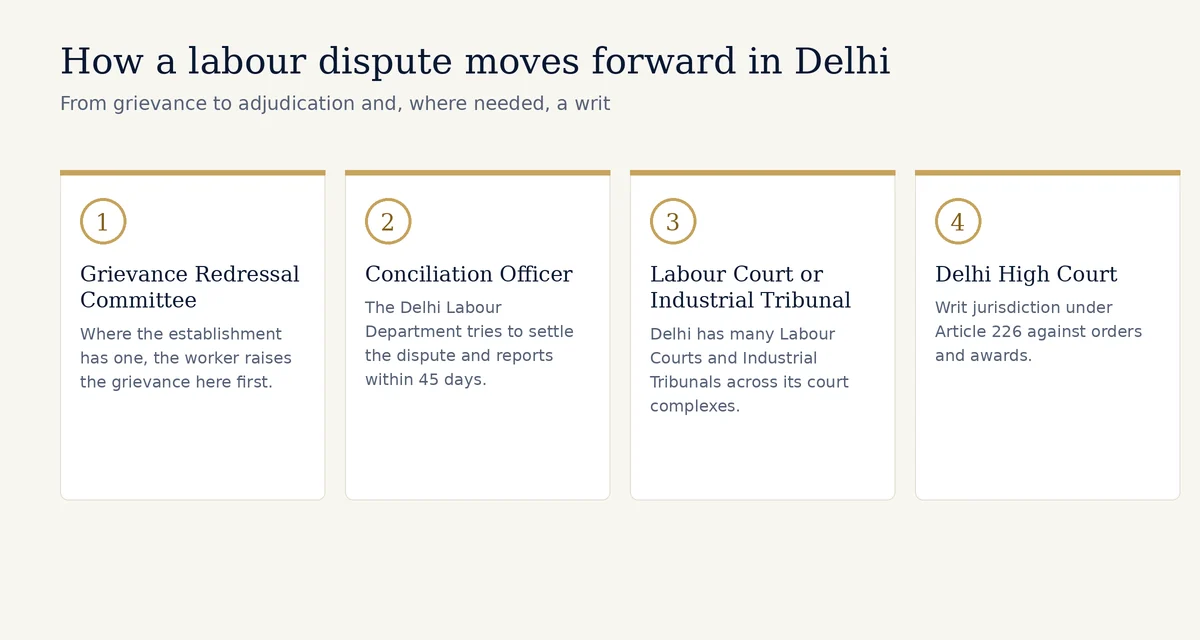
The statutory route has five stages, and a labour court lawyer in Delhi generally works out first which stage a client’s dispute has reached. The steps below follow the Industrial Relations Code.
- Grievance Redressal Committee.In an establishment with 20 or more workers, the worker files the grievance with the Committee within one year of the cause of action, and the Committee may complete its proceedings within 30 days.
- Conciliation.A worker aggrieved by the Committee’s decision, or whose grievance is not resolved in 30 days, can apply for conciliation within 60 days, through the trade union of which the worker is a member. The conciliation officer of the appropriate government tries to settle the dispute and reports within 45 days, or within 14 days where the matter involves a strike or lockout notice.
- Application to the Tribunal.If conciliation fails, a party can apply to the Tribunal. A worker covered by Section 4 can also apply directly after 45 days from the conciliation application, without waiting for the government to refer the dispute.
- Pleadings and evidence.The parties file their statements, and the Tribunal can examine evidence, summon witnesses and call for documents. The proceedings end in an award.
- Challenge.A party aggrieved by an order or award can file a writ petition in the Delhi High Court.
Time limits in a labour court case in Delhi
The Grievance Redressal Committee stage carries its own limits: one year to file with the Committee, 30 days for the Committee to complete its proceedings, and 60 days afterwards to apply for conciliation. Section 4(10) of the Industrial Relations Code then lets a worker apply directly to the Tribunal after the expiry of 45 days from the date of the conciliation application, and Section 4(11) requires that application to be made before the expiry of two years from the date of discharge, dismissal, retrenchment or termination of service. The Code also sets its own timelines for conciliation under Section 53.
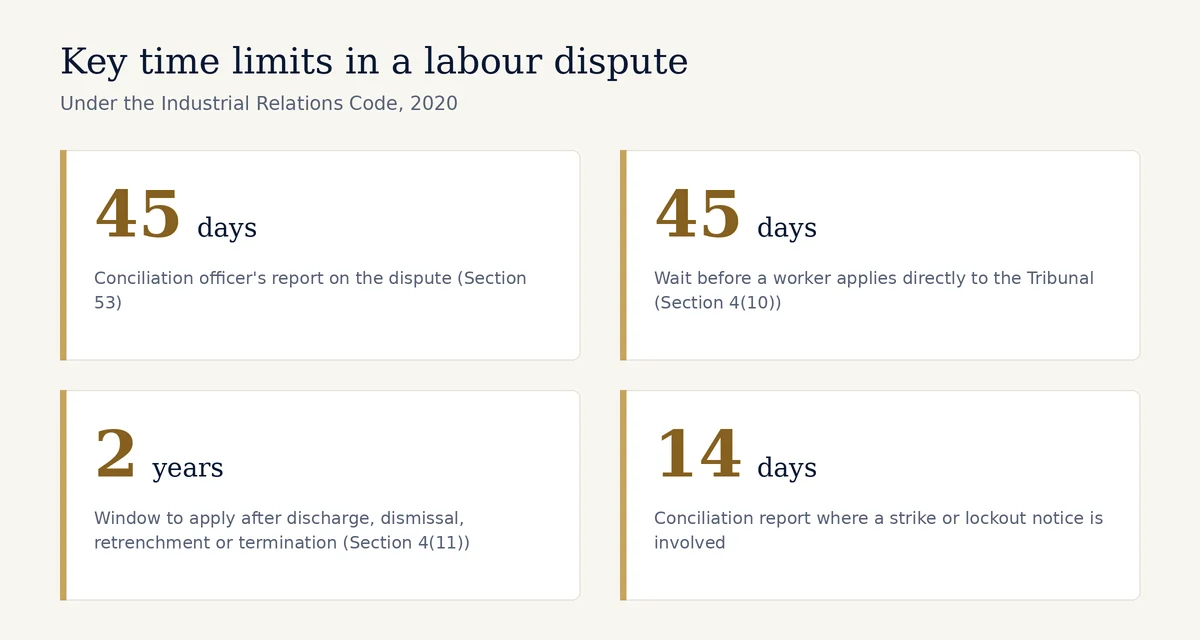
These dates are indicative. The statute and the Tribunal’s own directions govern each time limit, so check every date against the documents and the current Rules.
What disputes does a labour court in Delhi hear?
Most matters reach the Tribunal from conciliation, including termination, retrenchment, disciplinary action and similar industrial disputes. The Delhi courts’ own description is that majority of disputes are referred by the Government after a failure report, while some can be raised directly by the aggrieved party.
Other claims go to other forums. Statutory authorities handle matters such as wage claims and social security under their own Codes, and purely contractual claims follow civil procedure. The forum depends on the statute and the nature of the claim.
Challenging a labour court order in the Delhi High Court
The Delhi High Court exercises writ jurisdiction under Article 226 over the orders and awards of Tribunals and Labour Courts. That jurisdiction is supervisory. The High Court generally examines whether the decision is legally sound and the procedure fair, and it does not ordinarily re-weigh evidence the way an appeal would.
A labour court lawyer in Delhi preparing such a petition works from the record. A petition should be prepared with the award, the pleadings, the evidence and the record of proceedings, and should state clearly the legal ground of challenge.
What a labour court lawyer in Delhi does
A labour court lawyer in Delhi may appear for a worker, an employer or a union. The work generally covers drafting the statement of claim or written statement, leading and cross-examining evidence, appearing in conciliation, and arguing the matter. Appearance in these proceedings is governed by the Code, the Rules and the Tribunal’s procedure.
Bar Council of India rules do not permit an advocate to agree a fee that depends on the result of a case, and they restrict advertising and solicitation. This page is therefore limited to information about the forum and procedure.
Documents a labour court lawyer in Delhi reviews first
The record decides most labour disputes. These are the documents that are commonly relevant. Tick what is on hand.
0 of 8 gathered
Related reading
These pages on the site cover neighbouring areas of law.
Questions about a labour court lawyer in Delhi and labour courts
Where are the Labour Department’s district offices in Delhi?
Which establishments must have a Grievance Redressal Committee?
Is a trade union needed to apply for conciliation?
Can a labour court lawyer in Delhi appear in conciliation proceedings?
What does a labour court lawyer in Delhi do?
Where are the labour courts in Delhi?
Are there Central Government Industrial Tribunals in Delhi?
Which labour court hears a new dispute in Delhi?
Is there a help desk at the Delhi labour courts?
Do Labour Courts still exist after the Industrial Relations Code?
Who presides over a labour court in Delhi?
How can a worker approach the Tribunal after a dismissal?
What is the time limit for a dismissal dispute?
What does a conciliation officer do?
Can a labour court award be challenged?
Do all employment disputes go to the labour court?
Sources and authorities
- Delhi Government, Department of District and Sessions Judge: Labour Courts
- Delhi District Courts: list of Labour Courts and Industrial Tribunals
- Delhi Labour Department: adjudication machinery and allocation of references
- Delhi Labour Department: order creating new Labour Courts (2021)
- Delhi State Legal Services Authority: Help Desk for Labour Courts
- Delhi Government: Labour Authorities Case Management System, district offices
- Ministry of Labour: Central Government Industrial Tribunals
- India Code: the Industrial Relations Code, 2020
- PIB: the four Labour Codes made effective
- SCC Online: Kerala High Court on the continuation of Labour Courts
- Delhi Labour Department