
Non-profit law, legal information
NGO Registration in Delhi: Society, Trust or Section 8 Company
NGO registration in Delhi means choosing a legal structure, registering it with the right authority and then securing the tax registrations that make the organisation eligible for exemptions and donor deductions. This guide covers the three structures, the society documents, the new Income-tax Act sections, CSR-1 and FCRA, with two tools to test your plan.

NGO registration in Delhi: what it means and which law applies
An NGO is not a legal form in itself. NGO registration in Delhi means registering one of three structures: a society under the Societies Registration Act, 1860, a trust under a registered trust deed, or a Section 8 company under the Companies Act, 2013. Each has a different registering authority, a different governance model and different compliance.
NGO registration in Delhi creates the legal entity. The tax registrations, the NGO Darpan ID, CSR-1 and FCRA are separate steps that follow, and they depend on what the organisation does and how it is funded.
Why NGO registration in Delhi matters
A registered society or company has a legal identity that an informal group lacks. Under the Societies Registration Act, 1860, the property of a registered society belongs to it, vested in the governing body unless it is held by trustees, and the society can sue and be sued in the name of its president, chairman, principal secretary or trustees, as its rules decide.
Registration is also the starting point for what follows. A PAN and bank account in the organisation’s name, tax registration, grants, CSR partnerships and FCRA all typically ask for the registration certificate and the governing documents. An organisation that skips or delays this step often finds that funders and banks cannot work with it.
The choice of structure at NGO registration in Delhi is hard to reverse. Moving from a society to a company, or the reverse, means new documents and new approvals, so the early decision deserves care.
NGO registration in Delhi: the three structures compared
| Structure | Governing law | Registered with | People required | Suits you when |
|---|---|---|---|---|
| Society | Societies Registration Act, 1860 | Registrar of Societies | At least seven persons | The body is member-led and decisions are taken by an elected governing body. |
| Trust | Indian Trusts Act, 1882 | Trust deed registered with the Sub-Registrar | A settlor and trustees | A small group of founders wants to hold control through trustees. |
| Section 8 company | Companies Act, 2013 | Registrar of Companies, through the MCA | Directors; two for a private company | Company-law governance and filings suit the organisation and its funders. |
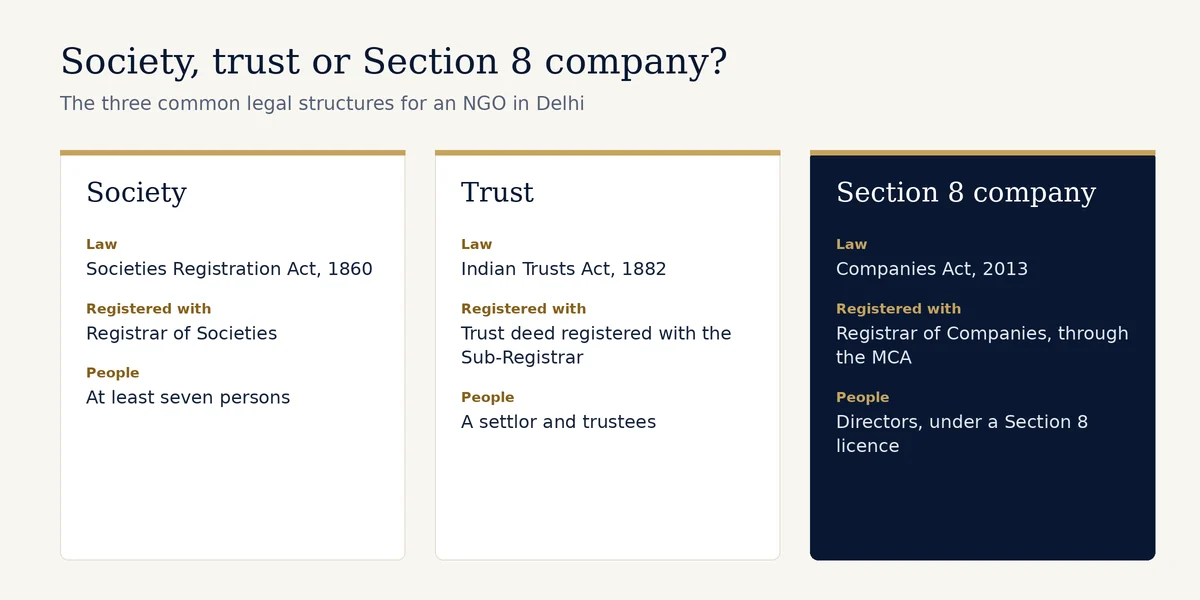
No structure removes the need for tax registration. Even after NGO registration in Delhi, a society, trust or Section 8 company must still apply separately for the charitable tax registrations discussed below.
Which NGO registration in Delhi route should you examine?
Answer three questions to see which structure and registrations are worth examining for your plan. The tool runs in your browser and stores nothing.
How to choose between a society, a trust and a Section 8 company
The three structures can all be used for NGO registration in Delhi, so the useful questions are about control, change and compliance. This table sets out how they differ on points that usually decide the choice.
| Question | Society | Trust | Section 8 company |
|---|---|---|---|
| Who controls it? | A governing body accountable to the members under the rules. | The trustees named in the deed. | The board of directors and the members, under company law. |
| How are the objects changed? | By a three-fifths vote at a second special meeting, after notice (Section 12). | As the deed provides, within the law. | Through the Companies Act process, subject to the licence conditions. |
| What is filed every year? | The governing body list (Section 4). | Accounts and tax filings as the law and the deed require. | Annual financial statements and returns with the Registrar of Companies. |
| What happens to surplus on closure? | It cannot be shared among members (Section 14). | It follows the deed and the law of charitable trusts. | The company cannot pay dividends; the licence conditions govern its assets. |
Rule of thumb for NGO registration in Delhi: choose a society when many people will share governance, a trust when a small group wants to hold control, and a Section 8 company when funders or founders want company-law discipline.
Society registration in Delhi: documents and procedure
For NGO registration in Delhi as a society, Section 1 of the Societies Registration Act, 1860 lets any seven or more persons form a society for a literary, scientific, charitable or other purpose listed in Section 20. They subscribe their names to a memorandum of association and file it with the Registrar. The memorandum states the name of the society, its object, and the names, addresses and occupations of the governing body.
A copy of the rules and regulations, certified as correct by at least three members of the governing body, is filed with the memorandum. Once the Registrar certifies registration, the society can sue and be sued in the name of its president, chairman or secretary, and its property vests in the governing body.
The Act as published by the Delhi Government sets a registration fee of fifty rupees, or a smaller fee that the State Government directs. Practical costs, such as stamp paper, notary charges and affidavits, are extra, and sources quote different totals. Confirm the competent Registrar's office, the current fee and the checklist before you file.
0 of 8 gathered
Every year, a registered society must file the list of its governing body with the Registrar within fourteen days after its annual general meeting (Section 4). Keep minutes and member records current.
Society rules: governance, changes and dissolution
Once a society completes NGO registration in Delhi, the Act and its own rules govern how it works. These provisions are worth knowing before the rules and regulations are drafted, because they shape what the rules can say.
Members and the governing body
A member is a person admitted under the rules who has paid a subscription or signed the roll and has not resigned (Section 15). A member whose subscription is more than three months in arrears cannot vote or be counted. The governing body is whoever the rules entrust with management, whether called council, committee, directors or trustees (Section 16).
Penalties in bye-laws
A bye-law can impose a money penalty for breaking a rule, and the penalty can be recovered in a court with jurisdiction. Where the rules do not provide for bye-laws, a general meeting can make one with the votes of three-fifths of the members present (Section 9).
Changing purposes or merging
The governing body sends the members a written report on the proposal, delivered at least ten days before a special meeting. It takes effect only if three-fifths of the members present agree at a second special meeting held a month after the first (Section 12).
Dissolution
At least three-fifths of the members must vote for dissolution at a general meeting, in person or by proxy. Where a government is a member or contributor, its consent is needed. After debts are paid, surplus cannot go to members and must pass to another society (Sections 13 and 14).
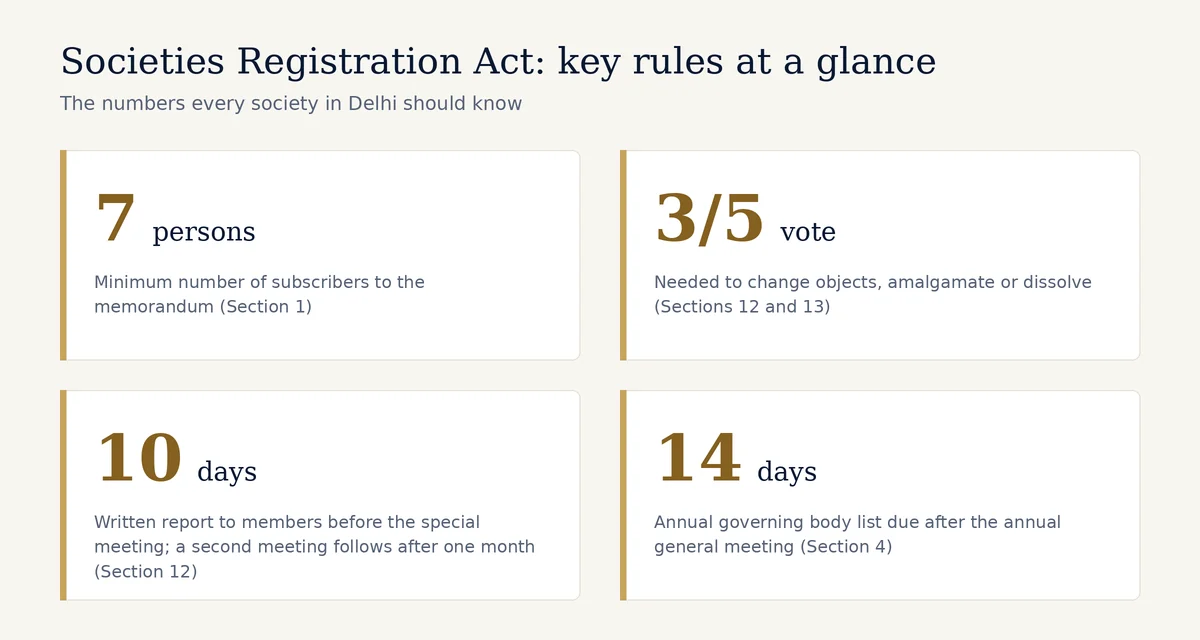
If the society’s rules do not provide for an annual general meeting, the list is due in January instead. Check your own rules for the meeting schedule.
Trust registration in Delhi and Section 8 company registration in Delhi
Both routes also count as NGO registration in Delhi, but the registering authority and the paperwork are different from a society.
Trust
A trust is created by a trust deed that names the settlor and trustees, states the objects and powers, and records the trust property. The deed is executed on stamp paper at the rate Delhi stamp law prescribes and registered with the Sub-Registrar. Check the stamp duty and witness requirements with the Sub-Registrar before you execute it.
Section 8 company
A company formed to promote charitable or similar objects needs a licence under Section 8 of the Companies Act, 2013, applied for through the MCA\u2019s incorporation process. Profits must be applied to the objects and cannot be distributed as dividends. It is a company, so annual financial statements and returns go to the Registrar of Companies. Compare it with a private limited company before choosing.
What a trust deed usually contains
- The name of the trust and the names of the settlor and trustees
- The objects, stated clearly and within charitable purposes
- The initial property or corpus
- The trustees’ powers, and how they are appointed, replaced or removed
- How accounts are kept and how decisions are recorded
- What happens to the property if the trust ends
What a Section 8 company’s documents state
- Objects that promote commerce, art, science, sport, education, research, social welfare, religion, charity or environmental protection
- A commitment to apply income and profits only to those objects
- A prohibition on paying dividends to members
- The directors, the members and the registered office
- Compliance with the conditions of the Section 8 licence
A licensed company may be allowed to omit “Limited” or “Private Limited” from its name. Check the current rules.
12A and 80G registration after the Income-tax Act, 2025
These registrations follow NGO registration in Delhi and apply to all three structures. The Income-tax Act, 2025 came into force on 1 April 2026 and replaced the 1961 Act. For NGOs, registration that used to be called 12A and 12AB now sits under Section 332, and approval for donor deductions that used to be 80G now sits under Section 354. The application forms are Form 104 for provisional registration or approval and Form 105 for regular registration or approval.
If you already hold 12A or 12AB
A valid registration on 1 April 2026 is treated as registration as a Registered Non-Profit Organisation for its remaining period, so there is no need to re-register only because the new Act has started.
If you are a new organisation
A new organisation that has completed NGO registration in Delhi should apply under Section 332 for registration and Section 354 for donor approval. Provisional registration is generally granted for three years, with regular registration to follow. Check the current rules and forms on the Income Tax portal before you file.
Questions about exemption, audit and returns for non-profits sit with an income tax lawyer.
CSR-1, NGO Darpan and FCRA registration in Delhi
Beyond NGO registration in Delhi itself, three further registrations matter only for some NGOs. An NGO Darpan ID is issued by NITI Aayog and is used for government grants and in FCRA applications. Organisations that want to implement CSR projects for companies generally register with the MCA in Form CSR-1 and need the charitable tax registrations described above.
FCRA registration is required to receive foreign contributions. Normal registration through Form FC-3A generally needs at least three years of existence and at least \u20b915 lakh spent on core activities in that period, and contributions must be received in a designated FCRA account at the State Bank of India, New Delhi Main Branch. A newer organisation tied to a specific foreign grant may look at prior permission through Form FC-3B instead. A certificate is valid for five years.
NGO registration in Delhi: step-by-step process
The order below applies to most cases of NGO registration in Delhi. Registration comes first, and the tax registration and optional approvals follow once the entity exists and holds its own PAN and bank account.
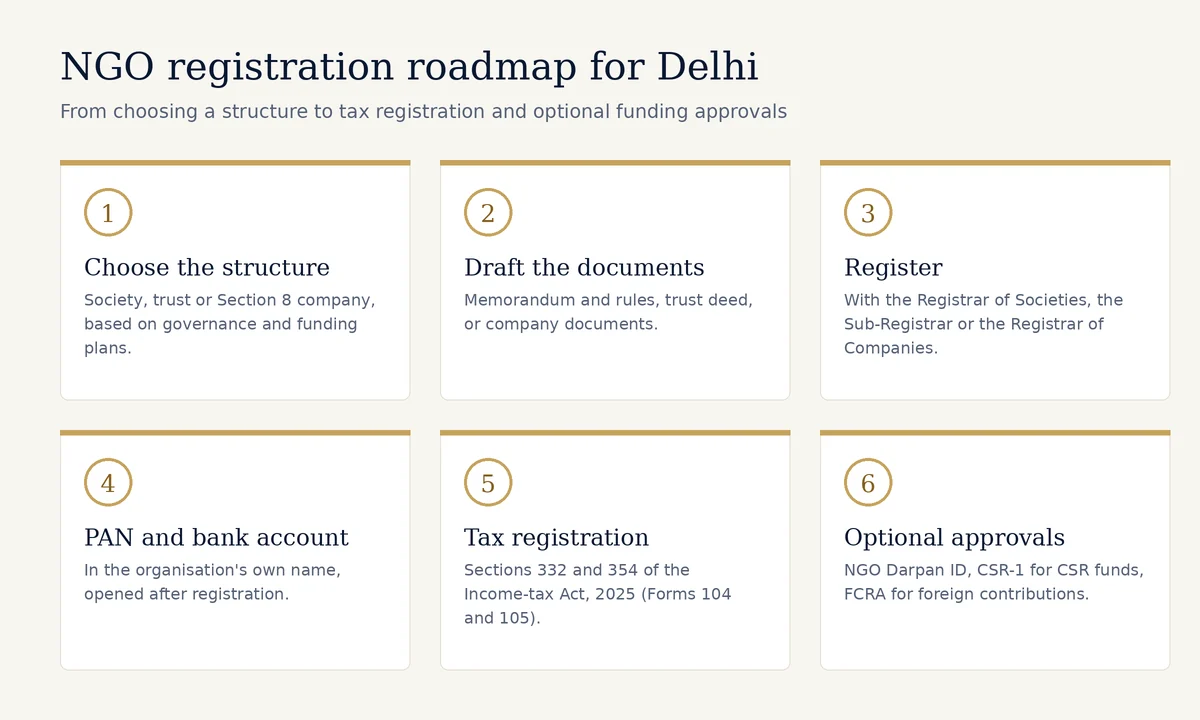
Plan the objects carefully. The objects clause drives the Registrar's review, the tax registration and any CSR or FCRA application. Draft it to match the work the organisation will actually do.
Before you file: points to check for NGO registration in Delhi
Most delays in NGO registration in Delhi come from avoidable gaps in the documents. This list covers the points that matter across all three structures.
- The objects clause is specific enough to describe the real work, and wide enough to allow growth
- Names, addresses and occupations match across the memorandum, the rules and the identity documents
- The name does not suggest government patronage or use protected emblems or names
- The registered office address is in Delhi and the proof of address is current
- Every signatory has signed in the right capacity, with the right number of signatures
- The organisation will keep its funds in its own bank account, never in a member’s personal account
- Donations and receipts will be recorded from day one, since tax approval and funders will ask for them
- The filing and meeting calendar is set before registration, including the annual list for a society
Related guides from Veeraya Legal
These pages cover neighbouring structures and matters that often come up alongside NGO registration in Delhi.
Questions about NGO registration in Delhi
Can a society own property after NGO registration in Delhi?
Who can sue on behalf of a society?
How can a society change its objects after NGO registration in Delhi?
What happens to a society’s assets when it is dissolved?
How long does NGO registration in Delhi take?
Which structure suits an NGO in Delhi?
How many persons are needed to register a society in Delhi?
What fee applies to society registration in Delhi?
Is 12A registration still needed after the Income-tax Act, 2025?
What replaced Section 80G?
Do I need FCRA registration?
What is NGO Darpan?
What must a registered society file every year?
Sources and authorities
Primary sources for NGO registration in Delhi:
- Delhi Government: the Societies Registration Act, 1860
- Income Tax Department: Income-tax Act, 2025, Rules and forms
- Ministry of Corporate Affairs: Section 8 licences and Form CSR-1
- FCRA Online Services: Ministry of Home Affairs
- NGO Darpan: NITI Aayog