
Family and matrimonial law, legal information
NRI Divorce Lawyer in Delhi: Jurisdiction, Foreign Decrees and Custody
An NRI divorce lawyer in Delhi deals with problems that an ordinary divorce does not: which Indian court has jurisdiction when one spouse lives abroad, whether a foreign divorce decree is valid in India, and how custody is decided when a child is in another country. This guide explains each question under Indian law, with three tools to test your own facts and dates.
NRI divorce lawyer in Delhi: six facts to know first
1. The Act reaches abroad
The Hindu Marriage Act, 1955 also applies to Hindus domiciled in India who are outside India (Section 1(2)).
2. Section 19 decides the court
A petition must go to the District Court in whose area one of five connecting facts exists, such as where the marriage took place or where the respondent lives.
3. A wife can file where she lives
If the wife is the petitioner, she can file where she resides on the date of the petition (Section 19(iiia)).
4. Timing rules
A petition within one year of marriage needs leave (Section 14), and a mutual consent petition needs one year of separate living (Section 13B).
5. A foreign decree is not automatic
A foreign divorce is recognised in India only if it passes Section 13 of the Code of Civil Procedure and the test in Y. Narasimha Rao.
6. Custody turns on welfare
India is not a party to the Hague Convention on child abduction, and its courts treat the child’s welfare as paramount.
Which law governs an NRI divorce in India
An NRI divorce lawyer in Delhi first identifies the governing law, which depends on the spouses’ religion and on how they married. Hindus, Buddhists, Jains and Sikhs are governed by the Hindu Marriage Act, 1955. A civil marriage, or an interfaith couple, may fall under the Special Marriage Act, 1954. Other communities have their own laws, such as the Indian Divorce Act, 1869, the Parsi Marriage and Divorce Act, 1936 and the Dissolution of Muslim Marriages Act, 1939.
The tools and rules below follow the Hindu Marriage Act. Other laws have their own jurisdiction and divorce provisions, so a petition under them needs separate checking.
NRI divorce lawyer in Delhi: where the petition can be filed
An NRI divorce lawyer in Delhi usually tests the Section 19 grounds before drafting anything. Section 19 of the Hindu Marriage Act requires a petition to be presented to the District Court within whose local limits one of five facts holds. The section does not deal with how long a person must have resided there, so even a short residence can be enough.
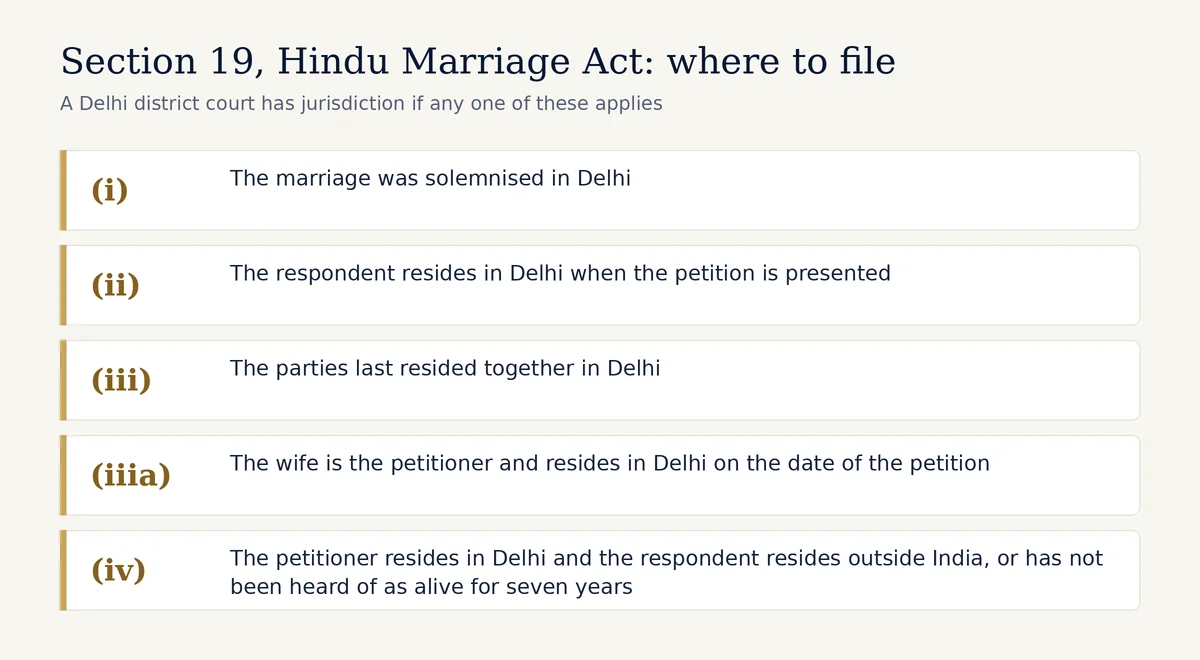
This is a screening tool, not a ruling. A petition must be filed in one court, and the connecting facts must exist on the date the petition is presented.
Delhi family courts for NRI divorce petitions
Matrimonial petitions in Delhi are heard by Family Courts set up under the Family Courts Act, 1984, which sit at the district court complexes. The court that hears a petition depends on the Delhi district to which Section 19 points.
| Family Court complex | Districts reported | Source |
|---|---|---|
| Karkardooma | East, North-East and Shahdara | Delhi Government, District Magistrate (East) page |
| Saket | South and South-East | Reported by a legal information site |
| Dwarka | South-West | Reported by a legal information site |
| Rohini | North and North-West | Reported by a legal information site |
| Tis Hazari | Central and West | Reported by a legal information site |
| Patiala House | New Delhi | Reported by a legal information site |
Confirm the allocation. Only the Karkardooma entry comes from an official Delhi Government page. An older Delhi courts document allotted districts differently, because the Saket and Dwarka complexes opened later, so the allocation has changed over time. Check the current position with the Delhi District Courts before filing.
NRI mutual consent divorce in Delhi
An NRI divorce lawyer in Delhi often meets mutual consent cases first, because both spouses may be abroad. Under Section 13B, spouses can seek divorce together if they have lived separately for one year or more and have agreed that the marriage should be dissolved. The petition is a first motion. A second motion follows no earlier than six months, and no later than eighteen months, after the petition is presented.
In Amardeep Singh v. Harveen Kaur (2017), the Supreme Court held that the six-month period is directory and can be waived where the marriage has broken down beyond reconciliation. In Shilpa Sailesh v. Varun Sreenivasan (2023), a Constitution Bench held that the Supreme Court itself can dissolve a marriage directly under Article 142, a power Family Courts and High Courts do not have. Appearance by video conference is governed by Santhini v. Vijaya Venketesh (2017), in which a three-judge bench held that in Family Court matrimonial proceedings video conferencing may be used after settlement efforts fail, on the joint application or consent of both parties, and in the court’s discretion. High Courts have applied this differently: the Gujarat High Court allowed an NRI spouse to take part in conciliation virtually, while the Andhra Pradesh High Court held video conferencing impermissible at the reconciliation stage. The Delhi Family Court’s own directions decide the position in Delhi.
The one-year and six-month rules are applied by the court case by case, and a waiver is a matter for the court. The dates here are for planning only.
Foreign divorce decrees and NRI divorce in India
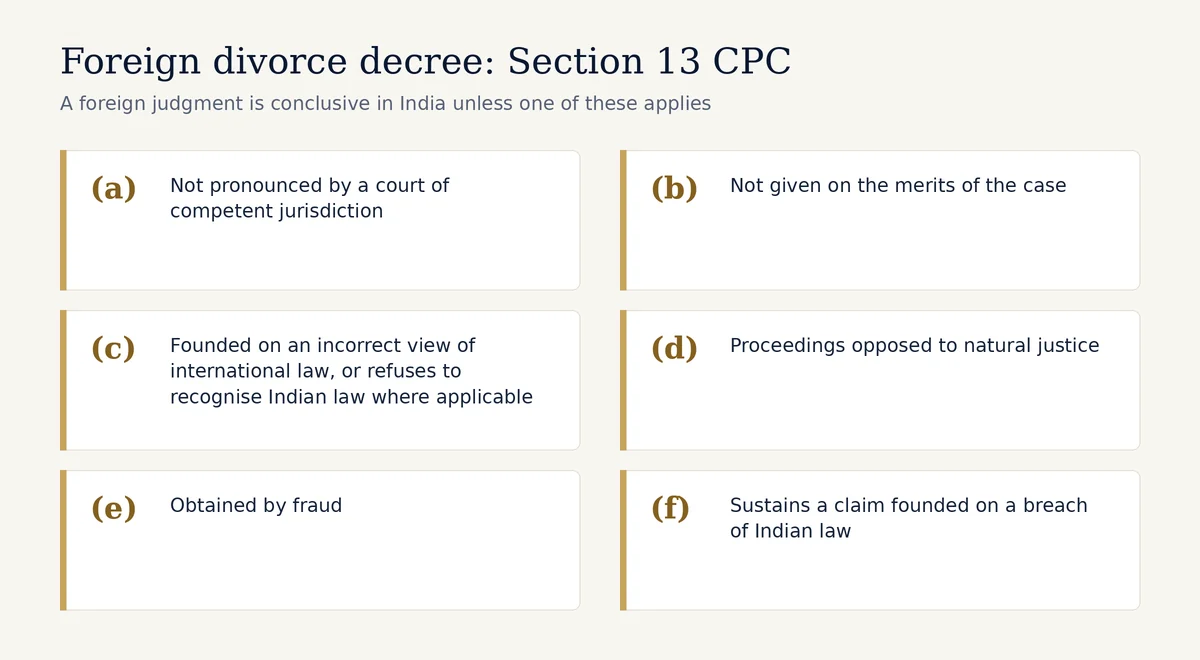
A foreign divorce decree does not end a marriage in India by itself. Section 13 of the Code of Civil Procedure makes a foreign judgment conclusive unless it falls within one of six exceptions. In Y. Narasimha Rao v. Y. Venkata Lakshmi (1991), the Supreme Court held that a foreign matrimonial decree is recognised only if the foreign court’s jurisdiction and the ground of relief accord with the matrimonial law under which the parties married. A decree passed ex parte, or on a ground such as irretrievable breakdown that the Hindu Marriage Act does not recognise, is unlikely to be recognised.
The Supreme Court applied this again on 15 January 2026 in Kishorekumar Mohan Kale v. Kashmira Kale. The spouses had married under Hindu rites. The Court held that a United States decree granted on irretrievable breakdown was not enforceable in India, because that is not a ground under the Hindu Marriage Act and the husband had not submitted to the US court’s jurisdiction. It then used Article 142 to grant a divorce after nearly 18 years of separation.
The checker flags issues that courts have treated as important. It does not decide whether a decree is valid.
Child custody in an NRI divorce
Custody is the part of an NRI divorce lawyer in Delhi’s work that most often involves a foreign court. India is not a signatory to the Hague Convention on the Civil Aspects of International Child Abduction. In Nithya Anand Raghavan v. State (NCT of Delhi) (2017), the Supreme Court held that an Indian court before which a child has been brought must ordinarily decide custody on the merits with the child’s welfare as the paramount consideration, treating a foreign court’s order as one factor and not as binding.
Section 26 of the Hindu Marriage Act allows the court to pass orders on the custody, maintenance and education of minor children in any proceeding under the Act, and Section 13 of the Guardians and Wards Act, 1890 makes the welfare of the minor the paramount consideration.
What an NRI divorce lawyer in Delhi does
An NRI divorce lawyer in Delhi may act for a spouse who lives in India or abroad. The work generally covers choosing the forum under Section 19, drafting the petition, handling service and appearance when a party is overseas, challenging or defending a foreign decree, and dealing with custody and maintenance.
Bar Council of India rules do not permit an advocate to agree a fee that depends on the result of a case, and they restrict advertising and solicitation. This page is therefore limited to information about the law and the forums.
Documents an NRI divorce lawyer in Delhi reviews first
These records are commonly relevant. Tick what is on hand.
0 of 8 gathered
Related reading
These pages on the site cover neighbouring areas of law, including the site’s overview of NRI divorce.
Questions about an NRI divorce lawyer in Delhi and NRI divorce
What does an NRI divorce lawyer in Delhi do?
Can an NRI file for divorce in a Delhi court?
Can a wife who lives in Delhi file here if the husband lives abroad?
Is a foreign divorce valid in India?
Is an ex parte foreign divorce decree valid in India?
Can an NRI get a mutual consent divorce without coming to India?
Has the Supreme Court recently ruled on a foreign divorce decree?
Is the six-month cooling-off period compulsory?
Who decides custody when a child lives abroad?
Can the Supreme Court dissolve a marriage directly?
Sources and authorities
- India Code: the Hindu Marriage Act, 1955, the Family Courts Act, 1984 and the Code of Civil Procedure, 1908
- Delhi Government, District Magistrate (East): courts, including the Karkardooma Family Court
- Delhi District Courts
- LiveLaw: Kishorekumar Mohan Kale v. Kashmira Kale (Supreme Court, 2026)
- LiveLaw: acceptance of foreign divorce decrees and the courts’ approach
- LiveLaw: video conferencing at the reconciliation stage (Andhra Pradesh High Court)
- Delhi High Court: MAT.APP.(FC) 111/2025 on waiver of the cooling-off period
- Supreme Court of India