
Intellectual property, legal information
Trademark Registration in Delhi: Process, Fees, Classes and Timeline
Trademark registration in Delhi means filing Form TM-A with the Trade Marks Registry, answering its examination report, surviving the opposition period and receiving a certificate that protects the mark for ten years. This guide explains each stage, the fee, the deadlines and the classes, with three tools to test your own plan.
Trademark registration in Delhi: what it protects
A trademark is a mark that identifies the goods or services of one business and distinguishes them from others. Under the Trade Marks Act, 1999, registration gives the owner the exclusive right to use the mark for the goods or services it covers and the right to sue for infringement. An unregistered mark can still be protected by an action for passing off, which usually takes more evidence to prove.
Trademark registration in Delhi gives a national right. The Registry office that handles the file depends on the applicant’s address, but the protection runs across India. A mark can be a word, a logo, a device or a combination, and the representation filed defines what is protected.
Where to file trademark registration in Delhi
Applications are filed online through the IP India portal. The Registry has five offices, and the one that handles a file is set by the applicant’s principal place of business in India or, failing that, the address for service. IP India lists the New Delhi office as covering Jammu and Kashmir, Punjab, Haryana, Uttar Pradesh, Himachal Pradesh, Uttarakhand, the National Capital Territory of Delhi and Chandigarh.
The New Delhi office of the Trade Marks Registry is at Bouddhik Sampada Bhawan, Plot No. 32, Sector 14, Dwarka. Hearings, where needed, can be attended by video conference under Rule 115, so physical presence is rarely required.
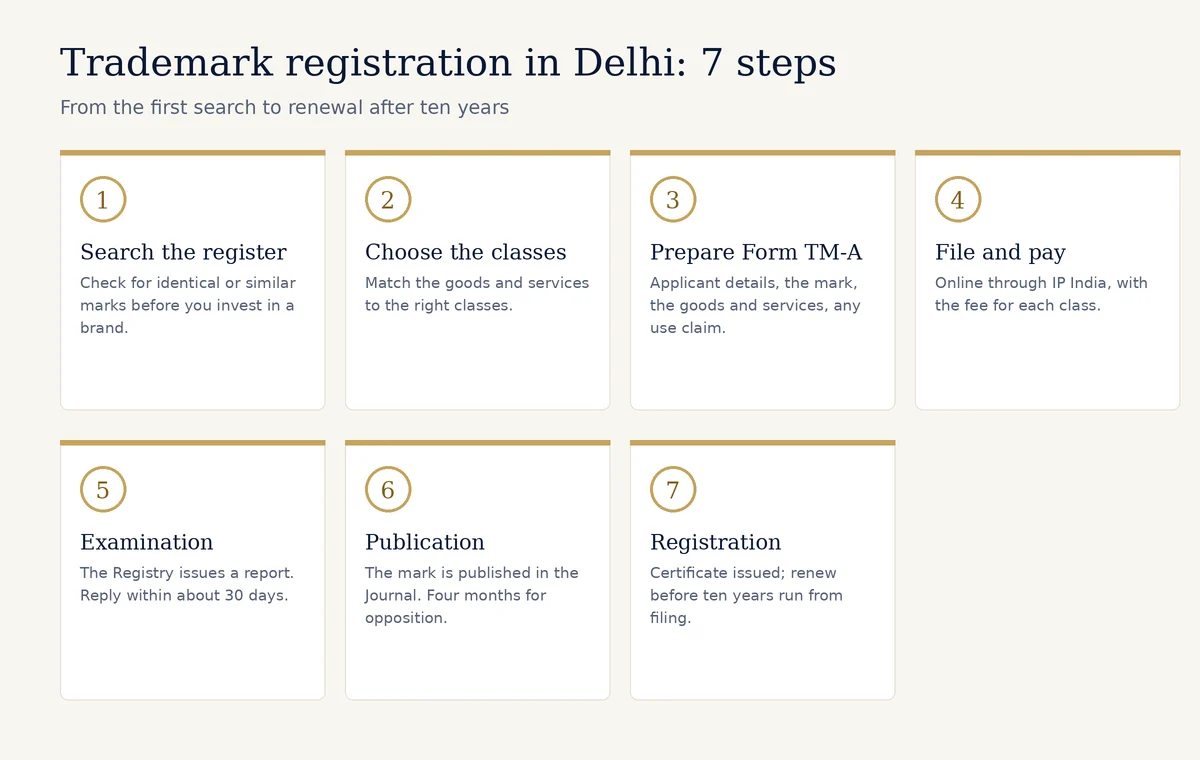
Trademark registration process in Delhi: seven steps
- Search the register.Look for identical or similar marks in the same or related classes before you commit to a brand. A clash with an earlier mark is a common ground of refusal.
- Choose the classes.Each class covers a group of goods or services and carries its own fee. Pick the classes that match what the business actually sells or offers.
- Prepare Form TM-A.The application states the applicant’s details, the mark, the goods and services and, if a prior use is claimed, the date of first use with a user affidavit.
- File and pay.File online and pay the fee for each class. The application is then examined for formalities.
- Reply to the examination report.The Registry examines the mark and issues a report. An objection must be answered within the time the Rules allow, and a hearing may follow.
- Publication and opposition.An accepted mark is published in the Trade Marks Journal, and any person can oppose it within four months.
- Registration and renewal.If there is no opposition, or it fails, the Registry issues the registration certificate. The registration lasts ten years and can be renewed.
No fixed timeline. The Registry does not promise a registration date. Commercial sources commonly quote one to two years, and a mark that meets no objection or opposition moves faster. An expedited examination is available under Rule 34 for an additional fee.
Classes for trademark registration in Delhi
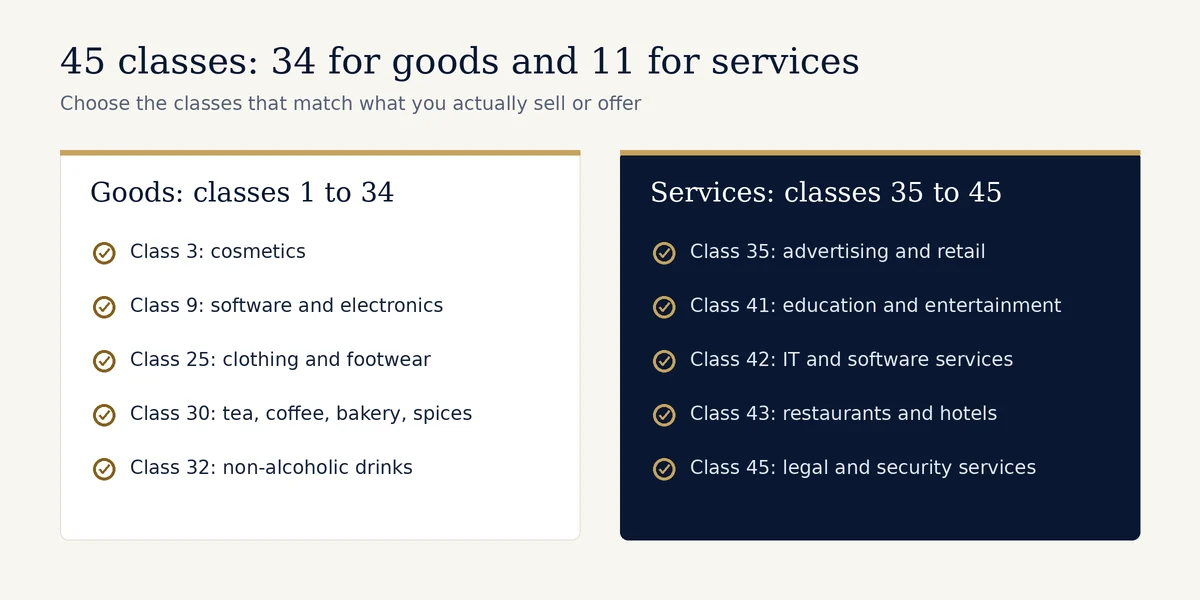
For trademark registration in Delhi, as elsewhere in India, applicants use the Nice Classification, which has 45 classes: 1 to 34 for goods and 35 to 45 for services. A mark is registered only for the classes in the application, so a brand that sells clothing and also runs a retail business may need both Class 25 and Class 35.
Trademark registration fees in Delhi
The government fee for trademark registration in Delhi is fixed under the First Schedule to the Trade Marks Rules, 2017 and is charged for each mark in each class. The fee for e-filing Form TM-A is ₹4,500 for an individual, a startup or a small enterprise and ₹9,000 for any other applicant. Physical filing costs ₹5,000 and ₹10,000. Professional charges are separate and vary.
The lower fee depends on the applicant meeting the Registry’s definition of an individual, startup or small enterprise, and the Registry may ask for proof. Later steps, such as an opposition or a renewal, carry their own fees. Confirm the amount on the IP India portal before you pay.
Documents for trademark registration in Delhi
For trademark registration in Delhi, IP India lists the core inputs for Form TM-A as the applicant’s details, a representation of the mark, a description of the goods or services, a user affidavit where a prior use is claimed, and a power of attorney where an agent files. Tick what you already hold.
0 of 8 gathered
Examination and objections: what the Registry can refuse
The Registry examines every application for trademark registration in Delhi on absolute grounds under Section 9 and relative grounds under Section 11. The applicant must respond within one month (30 days) of receiving the examination report under Rule 33(4), and the Registrar may treat the application as abandoned if no reply is filed. A limited extension can be requested on Form TM-M, and a hearing follows if the reply does not resolve the objection. If the Registry refuses the mark, an appeal lies to the High Court under Section 91.
| Objection | What it means | How applicants usually respond |
|---|---|---|
| Section 9(1)(a) | The mark lacks distinctive character. | Show how the mark identifies one business, with use and evidence. |
| Section 9(1)(b) | The mark describes the kind, quality or other feature of the goods. | Argue that the mark is suggestive, or add distinctive elements. |
| Section 9(1)(c) | The mark has become customary in the trade. | Show that the mark is not generic for the specific goods. |
| Section 11(1) | The mark is identical or similar to an earlier mark, with a likelihood of confusion. | Compare the marks and the goods, and consider consent or amendment. |
Missing the reply deadline can end the application. Keep the examination report date on record and treat the planner below as a starting point, not a substitute for the Registry’s own notice.
Trademark registration in Delhi: publication, opposition and key dates
Once the Registry accepts a mark, it is advertised in the Trade Marks Journal. Under Section 21, any person can oppose within four months of the advertisement. The applicant then files a counter-statement within two months of receiving the notice of opposition, and both sides lead evidence before a hearing.
These dates are indicative. The Registry’s own notices and the current Rules govern each deadline, so check every date against them.
After trademark registration in Delhi: symbols, validity and renewal
™ and ®
The ™ symbol can be used while an application is pending, since the Act does not restrict it. The ® symbol must be used only after registration. Section 107 punishes falsely representing a mark as registered with imprisonment up to three years, a fine, or both.
Validity and renewal
A registration lasts ten years from the date of the application and can be renewed for further ten-year periods. Under Rule 57, renewal can be filed up to one year before expiry. If the date is missed, renewal with a surcharge is possible within six months after expiry, and restoration can be requested within one year after expiry at the Registrar’s discretion, at a higher cost. Check the current fees on IP India.
Businesses that also trade abroad can look at international registration through the Madrid Protocol, which India has joined. That route has its own rules and costs.
Enforcing a trademark in Delhi
After trademark registration in Delhi, a registered owner can sue for infringement under Section 29 and an unregistered owner can sue for passing off. Delhi has a dedicated Intellectual Property Division in its High Court, which also hears appeals from the Registry’s orders on refusal and opposition. Whether a suit lies in the High Court or a district court depends on its value and on where the plaintiff or defendant carries on business.
Early action matters, since delay can weaken a claim for interim relief. For disputes and advice, see our pages on a trademark and copyright lawyer and an intellectual property lawyer.
Related guides from Veeraya Legal
These pages cover neighbouring matters that often come up alongside trademark registration in Delhi.
Questions about trademark registration in Delhi
How long does trademark registration in Delhi take?
What is the fee for trademark registration in Delhi?
Can I file for trademark registration in Delhi from another city?
Can I use the ™ symbol before registration?
What happens if the Registry raises an objection?
Who can oppose a trademark, and when?
How long does a trademark registration last?
Which court hears trademark appeals and disputes in Delhi?
Can I register a logo as well as a name?
Sources and authorities
Primary sources for trademark registration in Delhi:
- IP India: Trade Marks Registry offices and jurisdiction
- IP India: the Trade Marks Rules, 2017
- IP India online filing portal
- India Code: the Trade Marks Act, 1999
- Delhi High Court: Intellectual Property Division
Intellectual property, legal information
Trademark Registration in Delhi: Process, Fees, Classes and Timeline
Trademark registration in Delhi means filing Form TM-A with the Trade Marks Registry, answering its examination report, surviving the opposition period and receiving a certificate that protects the mark for ten years. This guide explains each stage, the fee, the deadlines and the classes, with three tools to test your own plan.
Trademark registration in Delhi: what it protects
A trademark is a mark that identifies the goods or services of one business and distinguishes them from others. Under the Trade Marks Act, 1999, registration gives the owner the exclusive right to use the mark for the goods or services it covers and the right to sue for infringement. An unregistered mark can still be protected by an action for passing off, which usually takes more evidence to prove.
Trademark registration in Delhi gives a national right. The Registry office that handles the file depends on the applicant’s address, but the protection runs across India. A mark can be a word, a logo, a device or a combination, and the representation filed defines what is protected.
Where to file trademark registration in Delhi
Applications are filed online through the IP India portal. The Registry has five offices, and the one that handles a file is set by the applicant’s principal place of business in India or, failing that, the address for service. IP India lists the New Delhi office as covering Jammu and Kashmir, Punjab, Haryana, Uttar Pradesh, Himachal Pradesh, Uttarakhand, the National Capital Territory of Delhi and Chandigarh.
The New Delhi office of the Trade Marks Registry is at Bouddhik Sampada Bhawan, Plot No. 32, Sector 14, Dwarka. Hearings, where needed, can be attended by video conference under Rule 115, so physical presence is rarely required.
Trademark registration process in Delhi: seven steps
- Search the register.Look for identical or similar marks in the same or related classes before you commit to a brand. A clash with an earlier mark is a common ground of refusal.
- Choose the classes.Each class covers a group of goods or services and carries its own fee. Pick the classes that match what the business actually sells or offers.
- Prepare Form TM-A.The application states the applicant’s details, the mark, the goods and services and, if a prior use is claimed, the date of first use with a user affidavit.
- File and pay.File online and pay the fee for each class. The application is then examined for formalities.
- Reply to the examination report.The Registry examines the mark and issues a report. An objection must be answered within the time the Rules allow, and a hearing may follow.
- Publication and opposition.An accepted mark is published in the Trade Marks Journal, and any person can oppose it within four months.
- Registration and renewal.If there is no opposition, or it fails, the Registry issues the registration certificate. The registration lasts ten years and can be renewed.
No fixed timeline. The Registry does not promise a registration date. Commercial sources commonly quote one to two years, and a mark that meets no objection or opposition moves faster. An expedited examination is available under Rule 34 for an additional fee.
Classes for trademark registration in Delhi
For trademark registration in Delhi, as elsewhere in India, applicants use the Nice Classification, which has 45 classes: 1 to 34 for goods and 35 to 45 for services. A mark is registered only for the classes in the application, so a brand that sells clothing and also runs a retail business may need both Class 25 and Class 35.
Trademark registration fees in Delhi
The government fee for trademark registration in Delhi is fixed under the First Schedule to the Trade Marks Rules, 2017 and is charged for each mark in each class. The fee for e-filing Form TM-A is ₹4,500 for an individual, a startup or a small enterprise and ₹9,000 for any other applicant. Physical filing costs ₹5,000 and ₹10,000. Professional charges are separate and vary.
The lower fee depends on the applicant meeting the Registry’s definition of an individual, startup or small enterprise, and the Registry may ask for proof. Later steps, such as an opposition or a renewal, carry their own fees. Confirm the amount on the IP India portal before you pay.
Documents for trademark registration in Delhi
For trademark registration in Delhi, IP India lists the core inputs for Form TM-A as the applicant’s details, a representation of the mark, a description of the goods or services, a user affidavit where a prior use is claimed, and a power of attorney where an agent files. Tick what you already hold.
0 of 8 gathered
Examination and objections: what the Registry can refuse
The Registry examines every application for trademark registration in Delhi on absolute grounds under Section 9 and relative grounds under Section 11. The applicant must respond within one month (30 days) of receiving the examination report under Rule 33(4), and the Registrar may treat the application as abandoned if no reply is filed. A limited extension can be requested on Form TM-M, and a hearing follows if the reply does not resolve the objection. If the Registry refuses the mark, an appeal lies to the High Court under Section 91.
| Objection | What it means | How applicants usually respond |
|---|---|---|
| Section 9(1)(a) | The mark lacks distinctive character. | Show how the mark identifies one business, with use and evidence. |
| Section 9(1)(b) | The mark describes the kind, quality or other feature of the goods. | Argue that the mark is suggestive, or add distinctive elements. |
| Section 9(1)(c) | The mark has become customary in the trade. | Show that the mark is not generic for the specific goods. |
| Section 11(1) | The mark is identical or similar to an earlier mark, with a likelihood of confusion. | Compare the marks and the goods, and consider consent or amendment. |
Missing the reply deadline can end the application. Keep the examination report date on record and treat the planner below as a starting point, not a substitute for the Registry’s own notice.
Trademark registration in Delhi: publication, opposition and key dates
Once the Registry accepts a mark, it is advertised in the Trade Marks Journal. Under Section 21, any person can oppose within four months of the advertisement. The applicant then files a counter-statement within two months of receiving the notice of opposition, and both sides lead evidence before a hearing.
These dates are indicative. The Registry’s own notices and the current Rules govern each deadline, so check every date against them.
After trademark registration in Delhi: symbols, validity and renewal
™ and ®
The ™ symbol can be used while an application is pending, since the Act does not restrict it. The ® symbol must be used only after registration. Section 107 punishes falsely representing a mark as registered with imprisonment up to three years, a fine, or both.
Validity and renewal
A registration lasts ten years from the date of the application and can be renewed for further ten-year periods. Under Rule 57, renewal can be filed up to one year before expiry. If the date is missed, renewal with a surcharge is possible within six months after expiry, and restoration can be requested within one year after expiry at the Registrar’s discretion, at a higher cost. Check the current fees on IP India.
Businesses that also trade abroad can look at international registration through the Madrid Protocol, which India has joined. That route has its own rules and costs.
Enforcing a trademark in Delhi
After trademark registration in Delhi, a registered owner can sue for infringement under Section 29 and an unregistered owner can sue for passing off. Delhi has a dedicated Intellectual Property Division in its High Court, which also hears appeals from the Registry’s orders on refusal and opposition. Whether a suit lies in the High Court or a district court depends on its value and on where the plaintiff or defendant carries on business.
Early action matters, since delay can weaken a claim for interim relief. For disputes and advice, see our pages on a trademark and copyright lawyer and an intellectual property lawyer.
Related guides from Veeraya Legal
These pages cover neighbouring matters that often come up alongside trademark registration in Delhi.
Questions about trademark registration in Delhi
How long does trademark registration in Delhi take?
What is the fee for trademark registration in Delhi?
Can I file for trademark registration in Delhi from another city?
Can I use the ™ symbol before registration?
What happens if the Registry raises an objection?
Who can oppose a trademark, and when?
How long does a trademark registration last?
Which court hears trademark appeals and disputes in Delhi?
Can I register a logo as well as a name?
Sources and authorities
Primary sources for trademark registration in Delhi:
- IP India: Trade Marks Registry offices and jurisdiction
- IP India: the Trade Marks Rules, 2017
- IP India online filing portal
- India Code: the Trade Marks Act, 1999
- Delhi High Court: Intellectual Property Division